

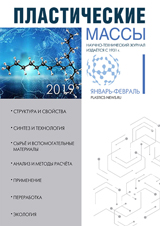
Scientific and technical magazine has been published from 1931 (continuously from 1959 to present).
The magazine publishes sci-tech articles on plastics and fibreglass synthesis and technologies, the results of R&D researches dedicated to the structure and properties of the plastic materials, articles on various mathematical research methods and latest equipment development.
The magazine covers a wide range of topics: processing (including secondary recycling), application of the plastic materials in various sectors, situation at the plastic materials production enterprises.
It also reviews the latest R&D development at the plastics research organisations, publications in domestic and overseas periodicals on plastic technologies.
The magazine also publishes information on the speciality and specialists training courses in polymers industry at the higher education establishments; topical exhibitions, conferences, seminars; detailed review of the most significant events in the polymeric industry.
Current issue
STRUCTURE AND PROPERTIES
The article presents the main characteristics of various grades of carbon black (CB) required for designing the compositions and structure of dispersely fi lled polymer composite materials (DFPCM) with specifi ed electrophysical properties.
The maximum packing of CB particles of diff erent grades was determined experimentally, formulas were given for calculating the fi ller content and obtaining DNPCM with diff erent types of lattices and dispersed structures.
Using CB grade T-900 and high-density polyethylene as an example, composite materials with diff erent electrophysical properties, which depend on the lattice parameters (coordination number) and the dispersed structure (generalized parameter Θ), have been obtained.
A comparative study of modifi ed polyphenylene sulfide (PPS) compounds containing a polyolefin elastomer, ethylene-glycidyl methacrylate copolymer, and ionomer was performed. Thermal, rheological, and mechanical properties were investigated. The developed materials demonstrated high thermal stability and impact strength and showed performance characteristics comparable to those of commercial foreign analogues.
Syntactic foams based on epoxydiane resin with densities ranging from 0.23 to 0.67 g/cm³ were produced. Their physical, physicomechanical, thermophysical, and radiophysical properties were determined at various temperatures. Long-term thermo oxidative aging of the syntactic foam specimens was carried out at 120, 150, 180, and 210 °C for exposure times of up to 500 hours. Relationships between the extent of polymer thermo-oxidative degradation and both the exposure time at elevated temperatures and the material density were established. The material structure was found to signifi cantly aff ect the rate of polymer thermo-oxidative degradation. The eff ect of aging on the physicomechanical properties of the materials was also investigated. Additionally, long term thermo-oxidative aging studies were performed on a widely used acrylimide foam.
Polypropylene-based composite materials filled with carbon fillers and polyaniline have been developed. It was found that all additives, at processing-compatible concentrations, slightly change the fluidity of the resulting compounds, improve thermal stability with a slight decrease in strength, and do not affect the frost resistance of the original polypropylene. The addition of carbon black was shown to impart electrical conductivity to polypropylene, whereas shungite provides antistatic properties. Composites containing both shungite and polyaniline have been developed; these materials exhibit antistatic behavior and color tones ranging from gray to green, which makes them promising for use in critical engineering applications.
SYNTHESIS AND TECHNOLOGY
The process of obtaining artifi cial aqueous polyetherimide (PEI) suspensions by emulsifying a PEI solution in chloroform, followed by solvent distillation in the presence of cationic surfactants of the azole series with various structures, has been studied. The results obtained indicate that, in the presence of the studied cationic surfactants, it is possible to obtain stable artifi cial aqueous polyetherimide suspensions with positively charged particles having an average particle diameter in the range from 530 to 4400 nm.
The study investigates the eff ect of synthesis conditions of polyphenylene sulfi de on its physicochemical and processing properties. The variation of melting temperature and melt fl ow rate with the concentration of residual chlorine end-groups, measured by X-ray fl uorescence spectroscopy, was determined. On the basis of these fi ndings, composite formulations comprising polyphenylene sulfi de and carbon fi ber were developed for subsequent shaping of products by extrusion.
RAW AND AUXILIARY MATERIALS
This paper presents the results of research on the modifi cation of heat-resistant epoxy compositions with rubber components for their use in polymer composite materials for structural purposes.
The rheological properties of uncured epoxy compositions based on ED-20 resin modified with liquid products from wood waste pyrolysis (bio-oil) were studied. Unmodified resin and a composition with a conventional plasticizer, dibutyl phthalate, were used as references. Various methods of preparing and combining the modifying additive upon its introduction into the epoxy matrix were considered. Rotational viscometry was used to determine the dynamic viscosity of the compositions as a function of shear rate and temperature, as well as the kinetics of viscosity changes during long-term storage. The apparent activation energy of viscous flow was calculated over a temperature range from 20°C to 130°C. It has been shown that the modifi ed compositions tend to increase in viscosity over time, and the degree of change depends on the method of preliminary preparation of the pyrolysis liquid. The highest stability was recorded for the composition containing a combination of bio-oil and dibutyl phthalate. The observed increase in viscosity and activation energy indicates a change in the molecular structure of the modified compositions during long-term storage. The results obtained are necessary for predicting the processing properties and determining the allowable storage duration of epoxy compositions based on renewable raw materials.
ANALYSIS AND CALCULATION METHODS
Thermal transitions were investigated in longitudinal and transverse sections of birch wood, considered as a linear polymer. Pyroelectric currents and the resulting polarization were found to diff er markedly between longitudinal and transverse cuts. The authors relate this eff ect to changes in the mobility of charged kinetic fragments of the macromolecular chain with section type, indicating anisotropy in the thermopolarization characteristics of the samples.
APPLICATION
This study assessed the resistance of a new polypropylene pipe grade developed by SIBUR Holding PJSC to aging in a chlorine-containing environment, compared to a similar grade with proven chlorine resistance. It is shown that the SIBUR grade of standard random propylene–ethylene copolymer is not inferior to the reference material (a standard random polypropylene copolymer from a competing manufacturer) with respect to chlorine resistance.
RECYCLING
Highly fi lled composites based on various polyethylene grades and ground rubber from automotive tires (rubber-plastics) have been investigated. It is shown that materials containing 65–80 vol.% rubber particles retain the ability to deform up to 70–120%. The failure of highly fi lled rubber–plastics is caused by the formation and development of critical defects – microcracks growing across the draw axis. The elongation at break of highly fi lled composites is linearly dependent on the crack resistance of the matrix polymer, characterized by its fracture toughness. It has been established that blending polymers with high crack resistance is a promising approach for obtaining highly fi lled materials whose elongation at break exceeds that of composites based on the individual polymers comprising the blend.


